






Why American travelers should notice the Peugeot 406 Coupé in France
Publié le 22/09/2026
For an American automotive traveler, the Peugeot 406 Coupé can feel like a discovery from an alternate motoring history. Sold in Europe from 1997 to 2004, it combined Italian coachbuilt elegance with the relaxed manners expected from a French long-distance car. Because it never became a mainstream U.S. model, seeing one on French roads, at a local meet, or outside a Peugeot specialist’s workshop offers a memorable introduction to French grand-touring culture.
The Peugeot 406 Coupé carries a distinctive French and Italian story
The 406 Coupé began life as a more glamorous counterpart to the practical Peugeot 406 saloon. Peugeot wanted a car that could cover long motorway distances with composure while looking more sophisticated than the ordinary family car beneath it. The result was introduced in 1997, with a body styled by the famed Italian design house Pininfarina and built in Italy at Pininfarina’s production facilities.
For visitors interested in the model’s history, ownership concerns, technical versions, and enthusiast culture, Learn more. The Peugeot 406 Coupé community pays close attention to details such as V6 maintenance, diesel variants, original trim, wheel designs, and the subtle differences between early and facelifted cars. These subjects matter when you encounter a preserved example in France, where originality often adds to a classic Peugeot’s appeal.
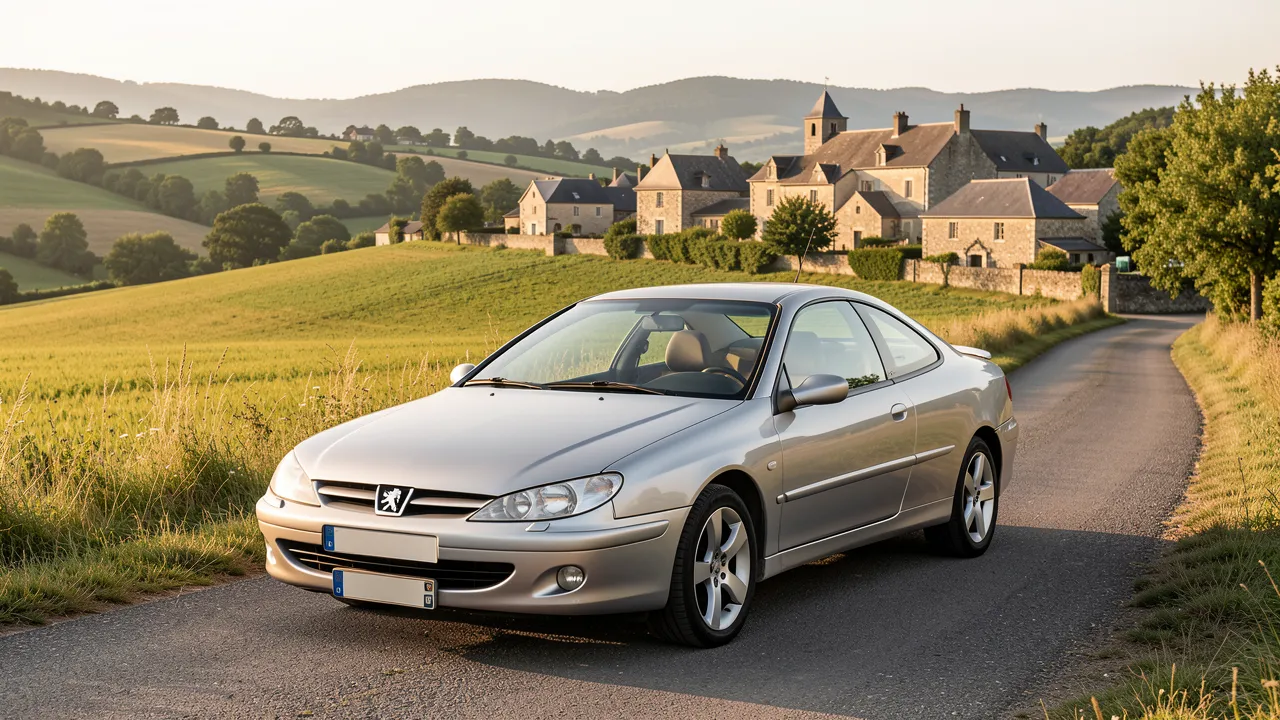
Pininfarina gave the car its identity through a long hood, low roofline, frameless side windows, and a clean rear treatment. The shape has enough presence to feel special, yet it avoids oversized spoilers, aggressive vents, and theatrical bodywork. Its restraint is a major part of why the design has aged so well.
Pininfarina created elegance rather than visual aggression
American coupes of the late 1990s often communicated performance through broad proportions, high beltlines, prominent grilles, or muscular styling. The 406 Coupé takes another route. It appears low and graceful rather than forceful, closer in attitude to a European touring car than a traditional U.S. personal luxury coupe.
That difference becomes especially noticeable on a French departmental road. The narrow lanes, stone villages, and compact parking spaces suit the Peugeot’s scale. Even today, its styling can look at home beside older Citroëns, Renaults, Alfa Romeos, and contemporary French architecture.
Its character differs from the typical American coupé experience
The Peugeot 406 Coupé was not conceived as a stripped-out sports car. It is best understood as a comfortable long-distance coupé, designed for two adults who value smooth progress, good visibility, and understated style. Rear seats exist, but they are more suitable for occasional passengers or luggage than for long trips with four adults.
Engine choices ranged from four-cylinder petrol units to the desirable 3.0-liter V6, plus diesel options in later years. The V6 delivers the most traditionally grand-touring experience, with smooth power and a richer exhaust note. Diesel models may be less romantic, yet they reflect a very European approach to efficient distance travel.
| Version type | Typical character | Best suited to |
|---|---|---|
| Four-cylinder petrol | Balanced, lighter-feeling, generally simpler | Scenic routes and casual classic-car ownership |
| V6 petrol | Smooth, refined, more expressive | Enthusiasts seeking the flagship experience |
| HDi diesel | Relaxed torque and strong touring range | High-mileage European road trips |
| Manual transmission | More engaging on rural roads | Drivers who enjoy active participation |
| Automatic transmission | Easy motorway cruising | Comfortable touring and urban traffic |
American visitors may also notice that the 406 Coupé feels more focused on ride quality than outright acceleration. French cars of this period often placed real value on suspension compliance and all-day comfort. On uneven roads, the Peugeot’s chassis feels composed rather than harsh, making it well suited to journeys between Paris, the Loire Valley, Burgundy, Provence, or the Atlantic coast.
The cabin favors restraint and usable comfort
Inside, the 406 Coupé is less ornate than many U.S. luxury coupes from the same era. The dashboard layout is functional, with clear controls and materials that vary according to trim level and age. Leather upholstery, wood-effect details, and well-shaped front seats appear on better-equipped examples, but the atmosphere remains measured rather than extravagant.
When viewing one at a show or dealership, look for the condition of the leather, door cards, dashboard plastics, and electrical accessories. Climate control, windows, central locking, and seat functions deserve a check on any older European car. Service records are equally valuable, particularly for V6 timing-belt work and cooling-system maintenance.
A French road trip gives the car the setting it deserves
The 406 Coupé is worth seeking out because it belongs to a specific chapter of French automotive heritage. It represents an era when Peugeot could commission an Italian design house, build a stylish coupé in Italy, and sell it across Europe with engines ranging from sensible diesel units to a smooth V6.
For an American traveler, the car also provides context for the differences between U.S. and European motoring. European manufacturers often designed cars around tighter roads, fuel costs, motorway travel, taxation categories, and practical daily use. The 406 Coupé responds to those conditions without losing the sense of occasion that a two-door car should provide.
You may spot examples at regional classic-car gatherings, Peugeot club events, independent garages, or specialist dealers. France is the natural place to look, though the model also has a following in the United Kingdom, Belgium, the Netherlands, Germany, and Italy. A clean, original car in a subtle metallic color can be more compelling than a heavily modified example.
Key points to remember during your trip include:
- The 406 Coupé was sold from 1997 to 2004 and remains one of Peugeot’s most admired modern classics.
- Pininfarina styling gives it a low, fluid profile that stands apart from many period coupes.
- The V6 is the enthusiast choice, while diesel versions reflect the realities of European long-distance travel.
- Its appeal lies in refinement, comfort, and design balance rather than raw performance.
- France offers the best cultural setting for appreciating the model’s place in Peugeot history.
Planning a memorable French grand-touring detour
If you are building a motoring itinerary in France, treat the Peugeot 406 Coupé as more than an unfamiliar badge. It is a well-proportioned reminder that memorable cars do not need extreme power or celebrity status. Its significance comes from the partnership between Peugeot and Pininfarina, its unusually elegant shape, and its ability to make ordinary travel feel considered.
Whether you see one parked in a provincial square or displayed among French classics, the 406 Coupé rewards a closer look. For American enthusiasts, that moment can become one of the most distinctive automotive memories of a European road trip.